- Red Team College Planning
- Posts
- Why College Admissions is a Vicious Cycle
Why College Admissions is a Vicious Cycle
Learn how to move the tide in your student's favor

Theresa Crowley
September 26, 2023
Brought to you by RED TEAM COLLEGE PLANNING
In this week’s edition of the Brilliant College Planning Newsletter, we bring you:
🚨 Upcoming Milestones/Deadlines
✏️ Insider Insight
📰 News on College Admissions/Financial Aid
💡Your Questions, Answered
Read Time: 4 minutes

Parent Fall Priorities
Senior Parents
The first early action application deadline for many colleges is October 15th.
Early decision (ED) is binding) and Early Action (EA) is non-binding.
Remind your student that starting the essay is the biggest hurdle.
Book a session with a pro if your student feels stuck or hasn’t started.
Junior and Sophomore Parents
Help your student start a LinkedIn account as soon as your student turns 16 to follow prospective colleges and post pictures of student accomplishments.
Freshmen Parents

Updates:
The Dept of Education says FAFSA will open around mid-December. We predict it may be closer to January 1st.
The CSS Profile (required by most Private colleges and some Public) will open on Oct 1, 2023. It is free for families making less than $100k.
Remember that even if you are high-income, you should submit these forms to be considered for merit (think academic and talent) scholarships.
News:


Colleges strive for top rankings in the US News and World Report. These rankings are highly influential in shaping a college's reputation and attracting prospective students.
As a parent, you likely have already searched how colleges rank on this list. And since parents care about the rankings, colleges have to care about the rankings…a lot.
Somewhere in America, there is an admissions dean who is slamming a table in frustration at their admissions team because the college’s ranking fell this year.
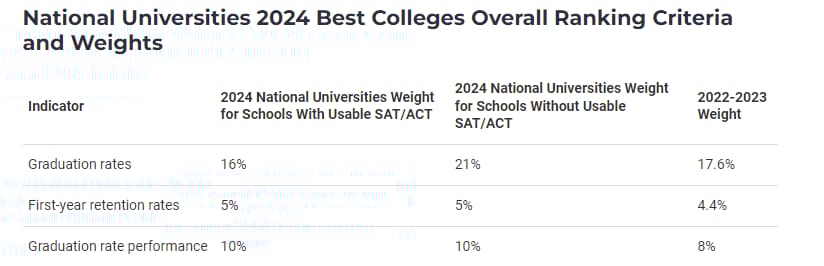
So what are the most important factors that move colleges up in the US News report ranking?
Graduation Rates.
So important that they’re listed twice and presented in two different ways.
Of the over 2,600 4-year accredited colleges in this country:
Top 100 colleges have +95% graduation rates.
Top 500 colleges have +75% graduation rates.
Bottom 2,000 colleges have -75% graduation rates.
So how can a college predict whether a student will graduate in 4 years to make sure their rankings don’t fall?
SAT and ACT scores are the quantitative data that correlate most highly with the likelihood of graduation, even more so than GPA. This makes sense since GPA systems vary drastically from school to school.
By placing emphasis on standardized test scores, colleges are able to predict how likely a student is to graduate.
While standardized test scores may not be the best indicator of a student's abilities or potential, the rankings system compels colleges to place importance on them in order to maintain a competitive edge in rankings and attract top-tier students.
High SAT/ACT→ better graduation rates → better rankings → more applicants.
And so goes the cycle.
However, colleges have a delicate balance to strike because they still have to attract high numbers of applicants. Since COVID-19, 80% of schools are test-optional. The last thing colleges want is a student not bothering to apply because they worry their test score is too low to get in…even if it is. This test-optional trend is part of the reason college application volume is up 30% from 2019.
Make no mistake, if your student scored above average at a given school on SAT or ACT, they should submit those scores. As we’ve said before, feed the algorithm if you want to get past a college’s first round of rejections.
If their scores are below average, help them come up with a better list of colleges for them.
If their scores are already above or at average for top universities, they’ll need to stand out among all the other top-score students. They’ll need to hit the values side, hard.

Parent Question: I’m in the final stages of helping my student apply for college. Things are getting heated in our house. How can I bring down the temperature?
It is completely normal for tensions to rise during the final stages of the college application process. Remember that this is a significant milestone in your student's life. They are probably more invested in the outcome than they may let on, hence the sensitivity around planning.
To bring down the temperature, try to create a calm and supportive environment at home. Encourage open and honest communication, allowing your student to express their concerns and fears.
Instead of jumping right into fix-it mode, let their concern rest and simply acknowledge it. Give it a day before asking them, "Would you like some help with this?”
Listen to their thoughts and opinions, and try to understand their perspective. Remind yourselves that this is a collaborative effort and that you are all working towards the same goal: finding the best college fit for your student. Take breaks when needed, engage in activities that help relieve stress, and celebrate small victories along the way.
I’m always reminded in my meetings with students, that students are worried about how their parents are doing in this process, too. It’s not just the reverse.
That being said, let’s face it…your student is at a stage in life where they scientifically crave autonomy. That’s not just normal but important for their development. In other words, this need for independence is a feature, not a bug.
If you want more support and details on how to help your student stand out and enjoy more independence in this process, book a spot in one of our free parent workshops.
Our results speak for themselves.
I love what I do and appreciate your feedback! If you have questions you want answered or specific topics you want covered, email me: [email protected]